


Ryyvo C40 Turntable with Adjustable Arm


Ryyvo C40 Turntable with Adjustable Arm
- You set the weight, not a factory.
- A cartridge with a name you can look up.
- A new stylus from any decent dealer.


Dispatched by 6 October
Before you decide
What do I actually get for my money?The deck alone. You supply the speakers.
In the box:
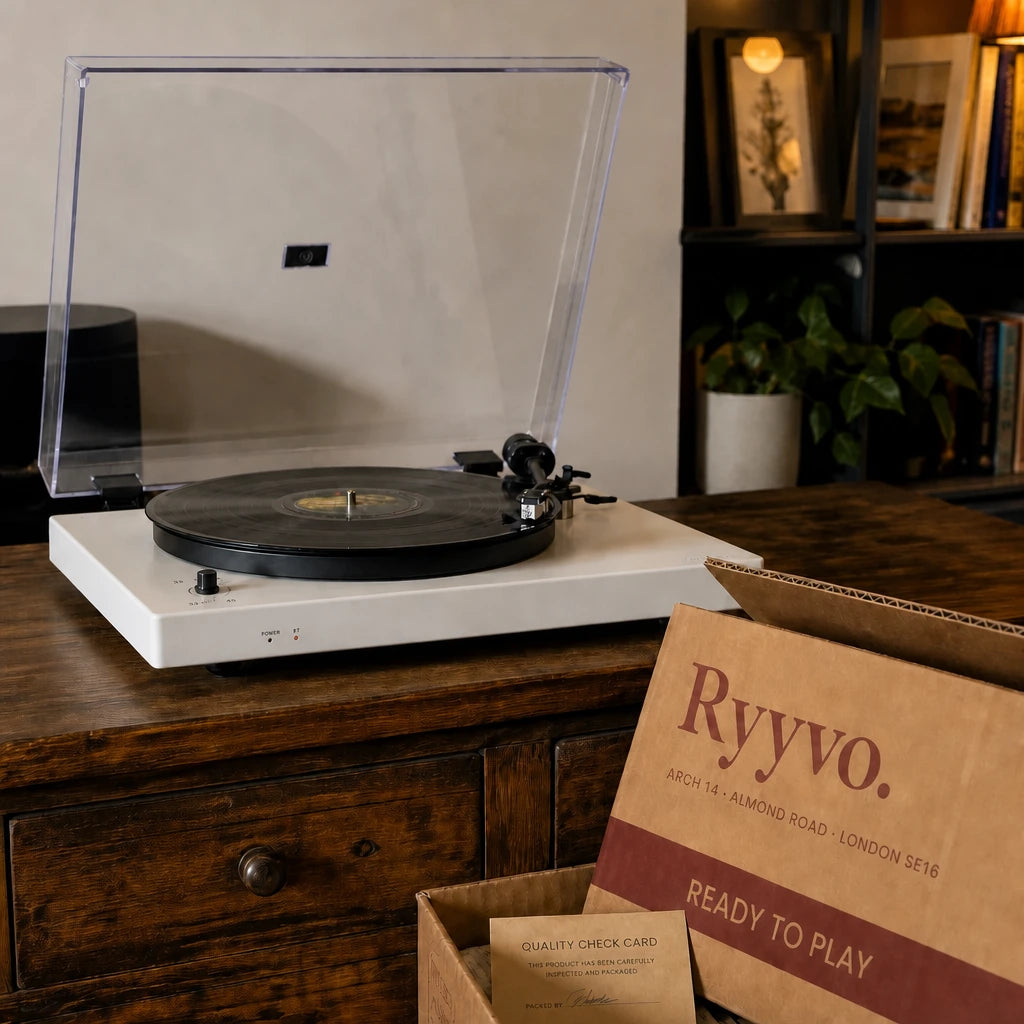
- The turntable, on a 36 mm plinth in matte white, with a full-size hinged dust cover
- An Audio-Technica AT-3600L cartridge, fitted at the factory
- A 1.6 kg iron platter and an aluminium tonearm with a calibrated counterweight
- A UK power adaptor and an RCA lead
- Printed instructions
Nothing in this box makes a sound on its own. The supply is 12 volts at 1 amp, which runs a motor, a preamp and a Bluetooth radio and nothing more. You need powered speakers, an amplifier, or a Bluetooth speaker. Powered speakers start around £60, and that is a real cost worth settling before you order rather than after.
Want one that works with nothing else?Will this damage my records?Audio-Technica AT-3600L. Moving magnet, diamond stylus, replaceable.
This is the deck in the range where the cartridge has a name, and that changes the answer completely.
The AT-3600L is a moving-magnet cartridge with a diamond stylus. Moving magnet tracks in the region of 1.5 to 2.5 grams rather than the 5 to 7 grams of a ceramic cartridge, so roughly four to five times less pressure in the groove. Its replacement stylus is a stock item from any decent dealer, which means the deck stays playable in five years without depending on us or on a factory in Guangdong.
The tonearm carries a threaded counterweight with a calibrated dial marked in half-gram steps. The downforce on your records is a number you set yourself, not one a factory chose and never told you.
Every play still wears a record a little. Correct tracking force slows it down considerably. It does not stop it, and no turntable at any price does.
Will it work with what I already own?RCA output, plus a Bluetooth transmitter to wireless speakers.
Two ways out of this deck, and between them they cover most homes:
- The RCA output on the back, into an amplifier, a soundbar with a line input, or powered speakers such as Edifier, KRK, Q Acoustics or Ruark
- A Bluetooth transmitter, which sends the record to a wireless speaker or headphones with nothing plugged in at all
The Bluetooth transmits. It does not receive, so you cannot stream a phone into this deck. Almost every listing in this trade says Bluetooth and stops there, and the two directions are completely different products.
It plays 33 and 45 rpm on 10 and 12 inch records. No 78s.
The maker has not stated whether the RCA output is line level or phono level, which decides whether your amplifier needs a PHONO input or a LINE one. We have asked. Tell us what you own and we will tell you before you order.
Tell us what you ownWhat if it is a gift, or I change my mind?
Both are covered by the same thing: 30 days to send it back for any reason. You do not need to explain yourself, but do contact us first so we can send you the return address.
Buying for someone else? Two things are worth knowing before you order, and neither of them is about the turntable:
- Whether they have anything to play it through. A deck with no speakers, given to somebody with no amplifier, makes no sound on the day. If you are not sure, choose one with its speakers in the box.
- Whether they already own records. If they have inherited a collection, the cartridge line above is the part that matters to them.
Every turntable also carries a two-year warranty covering parts and labour.
Tell us what they already own and we will tell you which one to get. If the answer is that they do not need anything from us, we will say that too.
Ask us before you buy01 — The object
What you are actually looking at.
The parts that decide how it plays, and what each one is for. Tap a number.
-
The cartridge, and it has a nameAudio-Technica AT-3600L
A moving-magnet cartridge with a diamond stylus, from a maker that has been building them since 1962. It tracks in the region of 1.5 to 2.5 grams rather than the 5 to 7 grams of a ceramic type, and its replacement stylus is a stock item from any decent dealer. Every other deck in this range arrives with a cartridge the factory declines to identify.
-
A counterweight you set yourselfCalibrated in half-gram steps
A threaded counterweight with a marked dial, so the downforce on your records is a number you control rather than one the factory chose and never told you. On the cheaper decks in this range the arm is balanced at the factory and that is the end of it.
-
The platter1.6 kg painted iron
Weight in a platter is what keeps the speed steady between the outside of a side and the middle. 1.6 kg of iron is not a flywheel from a broadcast deck, but it is a long way from the plastic disc you find under a suitcase player.
-
A full-size hinged dust coverCovers the whole plinth
It hinges rather than lifting off, so there is nowhere for it to end up leaning against a wall. Dust in a groove is played as noise, and it is the one form of record wear you can prevent entirely by closing a lid.
-
Two speeds33 and 45 rpm
33 and 45 cover essentially every record pressed today, on 10 and 12 inch discs. There is no 78 setting on this deck, so if you have inherited shellac this is not the one for it.
-
The plinth36 mm, matte white
A 36 mm painted board rather than a hollow box. Mass under a turntable is what stops footsteps on a suspended floor arriving at the stylus. The factory offers this mould in PVC veneer, matte paint and piano lacquer; we stock the matte white.
Specifications, exactly as the maker states them
The Ryyvo C40 is a turntable on a 36 mm painted plinth with a full-size hinged dust cover, a 1.6 kg iron platter and an aluminium tonearm. It is the first deck in this range fitted with a cartridge that has a name — an Audio-Technica AT-3600L — and the first with a counterweight you can actually set. Those two facts are why it costs what it costs, and they are what the rest of this page is about.
It is made in Guangdong, China, by BoTo, on a private mould, under the manufacturer's own reference TR-L40. We have not renamed the internals and we have not invented the numbers. Where the manufacturer has not stated something, it is written plainly further down this page rather than smoothed over.
Specifications published by the manufacturer
| Cartridge | Audio-Technica AT-3600L |
| Tonearm | Aluminium, with an adjustable calibrated counterweight |
| Platter | 1.6 kg painted iron |
| Playback speeds | 33 and 45 rpm |
| Record sizes supported | 10 inch and 12 inch |
| Speed variation | ± 1.5 % |
| Outputs and features | LP playback, RCA output, Bluetooth transmitter, automatic pause, full-cover dust protection |
| Power supply | DC 12 V, 1 A |
| Plinth | 36 mm density board |
| Finish on this model | Matte paint, white |
| Surface treatments offered by the factory | PVC veneer, matte spray paint, piano paint |
| Brand | BoTo |
| Manufacturer's model reference | TR-L40 |
| Country of manufacture | Guangdong, China |
| Private mould | Yes |
| Carton | 53 × 43 × 23 cm |
| Gross weight | 9.0 kg |
The cartridge has a name, and that is not a small thing
Every other deck in this range arrives with a cartridge the factory declines to identify. Ask what it is and you get a word — ceramic, ruby, moving magnet — and no model. That matters, because an unnamed cartridge is one you cannot replace, cannot research and cannot upgrade. When the stylus wears out, and it will, you are stuck.
This one is an Audio-Technica AT-3600L. It is a moving magnet cartridge from a company that has been making them since 1962, it is fitted to a very large number of turntables sold in Britain, and its replacement stylus is a stock item you can buy from any decent dealer. You are not dependent on us, or on a factory in Guangdong, to keep this deck playing in five years.
Moving magnet also means the output is designed to feed a phono stage, and that the stylus is a diamond rather than a chip of sapphire. Those are the two things that decide how long your records last.
You can set the tracking force yourself
The tonearm has a proper threaded counterweight with a calibrated dial on it. The manufacturer's own video shows the scale, marked in half-gram steps. That means the downforce on your records is a number you control, not a number the factory chose for you and never told you.
On the cheaper decks in this range the arm is balanced at the factory and that is the end of it. Here it is adjustable, and adjustable is the difference between a turntable and a record player.
We are not going to print a recommended figure we have not verified. Audio-Technica publishes a recommended tracking force for the AT-3600L, and we have asked the manufacturer to confirm in writing what this arm is shipped set to. Until that answer arrives, the calibrated dial on the counterweight is the number to go by, and it is yours to set.
The Bluetooth transmits. It does not receive.
Almost every listing for a deck like this says “Bluetooth” and stops there, which is useless, because the two directions are completely different products.
This one is a transmitter. It sends the sound of your record to Bluetooth speakers or headphones, wirelessly, with nothing plugged in. That is the useful direction for a turntable, and it is the one that lets you play a record through a speaker on the other side of the room.
What it does not do is the reverse: you cannot stream Spotify from your phone into this deck and out through something else. If that is what you wanted, this is not the machine.
There are no speakers, and there is an RCA output
Nothing in this box makes a sound on its own. The power supply is 12 volts at 1 amp — twelve watts, which runs a motor, a preamp and a Bluetooth radio and nothing more. That is exactly what you would expect from a deck that is meant to feed something else.
So you need speakers. Either Bluetooth ones, using the transmitter above, or wired ones through the RCA output on the back. If you already own an amplifier, powered speakers or a soundbar with a line input, you are ready. If you own nothing at all, look at the S20 or the A30 instead — they arrive with their speakers in the box.
33 and 45 only, on 10 and 12 inch records
No 78 rpm. If you have inherited shellac, this is not the deck for it.
The manufacturer lists 10 inch and 12 inch as the supported record sizes. It does not list 7 inch, and it does not mention a 45 rpm adaptor — the small puck that fills the wide centre hole on a single. The deck plays at 45 rpm, so 12 inch singles are covered, but whether a 7 inch adaptor is supplied is something we have asked and do not yet have in writing.
What is visible in the photographs
Read off the manufacturer's own images and videos, not written by them. Treat it as observation rather than specification.
- A single rotary control on the front left of the plinth, its collar marked 33 — OFF — 45, with two small indicator lamps above it marked POWER and BT
- An Audio-Technica headshell on the end of the arm, with the cartridge body visible and the stylus guard in place
- A counterweight at the back of the arm with a calibrated dial, the numbers 2.0 and 2.5 legible on the scale
- A full-size hinged clear dust cover, hinged at the back
- A black platter with a fitted mat
- A plinth in three different finishes across the manufacturer's images — a wood veneer, a gloss black and a matte white
- No speaker grille anywhere on the unit, in any finish, in any photograph
A note on the finish, and on the manufacturer's own listing
The wholesale listing this deck comes from shows it mostly in a wood veneer, while the technical sheet for the same reference documents the matte white. The factory offers three surface treatments — PVC veneer, matte spray paint and piano paint — which is where the three different-looking decks in the photographs come from. It is one mould with three skins.
We stock the matte white, which is the one the technical sheet describes.
While we are here: the listing is titled, in machine-translated English, “antique spinning top” and “recording player”. It is neither antique nor a recorder. It is a new turntable and it does not record.
Not stated by the manufacturer
These are the things we have asked for and do not yet have in writing. Nothing here is a defect; it is simply not confirmed, and we would rather you knew that than read a number we made up.
- The tracking force the arm is shipped set to, and the manufacturer's recommended range
- What automatic pause does exactly — whether the arm lifts at the end of the side, or only the platter stops
- Whether the RCA output is line level or phono level, and therefore whether a phono stage is built in
- Drive type — belt or direct
- Whether a 7 inch 45 rpm adaptor is supplied
- Whether the arm has anti-skate adjustment
- The Bluetooth version and codec
- Frequency response
- Product dimensions with the cover closed
- UK plug type and the adaptor supplied
- Exact box contents and cable lengths
- Manufacturer's warranty period
Delivery weight
9.0 kg gross. Carton 53 × 43 × 23 cm. The weight is in the platter and the plinth, which is the right place for it.
Do I need a phono preamp?
A record player puts out a much weaker signal than anything else in your house, so it needs a phono stage somewhere. The only question is where that stage sits.
If the deck comes with its own speakers, the phono stage is already inside and there is nothing to work out. If you are plugging into an amplifier, look on the back for a socket marked PHONO and use it. If your amplifier only has LINE, AUX or CD sockets, you need a deck with its own phono stage or a separate box from about £25.
This page states what this particular turntable has, and says so plainly where the maker has not told us.
Ask us what works with yoursWhen does the stylus need replacing?
A stylus wears out somewhere around 500 to 1,000 hours of playing, depending on the type. A worn stylus does not just sound duller — it damages every record you play with it. If you cannot remember ever changing one, it is probably due.
Where the maker names the cartridge, the replacement is a stock part you can buy from any decent dealer rather than something only we can supply. That is stated on this page for each model.
What if I get it home and it is the wrong one?
Thirty days to send it back for any reason. You do not need to explain yourself, but do contact us first so we can send you the return address. Keep the original box if you can - a turntable posted back loose tends to arrive damaged, and that becomes a problem for both of us.
Every turntable also carries a two-year warranty covering parts and labour.
Delivery and returnsWhen will it arrive, and what does delivery cost?
Delivery is free on every order across the United Kingdom, with no minimum spend and no surcharge for the Highlands or the islands. The expected date for your address is shown at checkout before you pay.
Everything travels tracked, and the tracking number reaches you by email once the parcel is collected.
Track your orderPut a record on tonight.
You open the box, lift the lid and drop the needle. If it turns out not to be the right one, you have thirty days to send it back.
- Free UK delivery
- 30 days to change your mind
- Two-year warranty
- A phone number that answers
This one £319
Still not sure? Ask usWhat else you need
One record needs more than one box.
The price of a turntable is not the cost of listening to records. Here is what is missing, said before you order rather than after.
-
 Most people start here
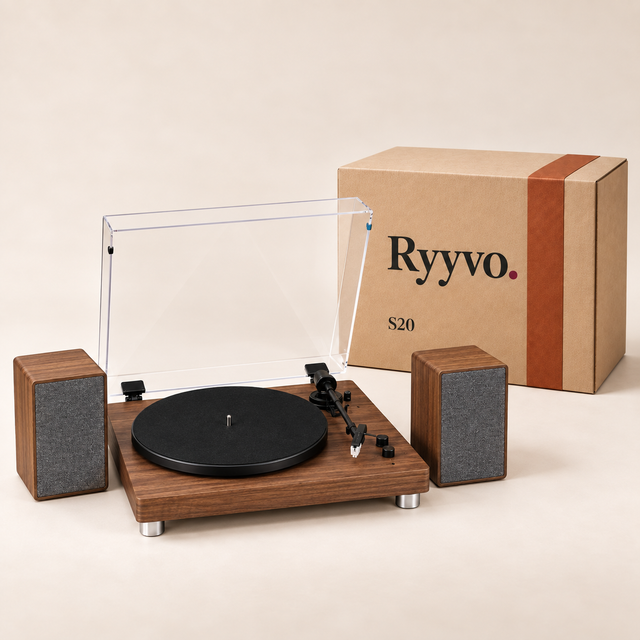
If you have nothing to play it throughS20Two stereo speakers in the box and nothing else to buy, with an RCA output for the day you want better.
£199
Have a look
Most people start here
If you have nothing to play it throughS20Two stereo speakers in the box and nothing else to buy, with an RCA output for the day you want better.
£199
Have a look
-
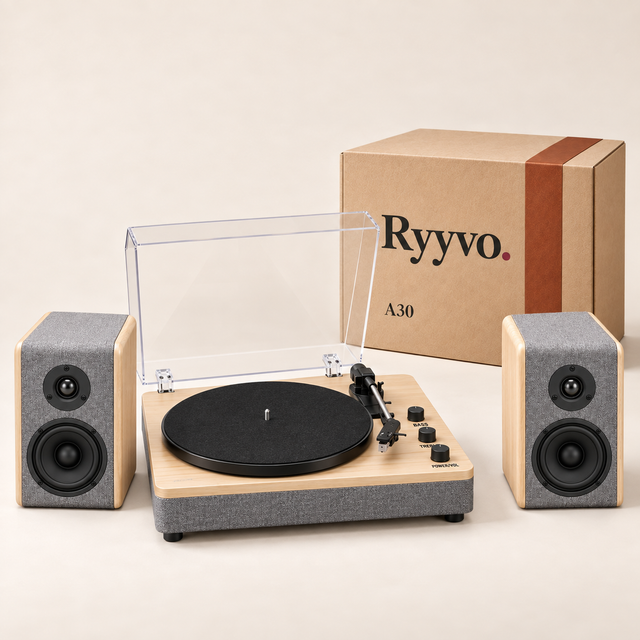 If there is inherited shellac to playA30Three speeds including 78, and an arm that takes itself off at the end of the side.
£269
Have a look
If there is inherited shellac to playA30Three speeds including 78, and an arm that takes itself off at the end of the side.
£269
Have a look
If none of this is what you need, tell us what you already own and we will tell you what works with it — including when the answer is that you do not need anything from us. Ask us