


Ryyvo A30 Turntable with Speakers and 78 rpm


Ryyvo A30 Turntable with Speakers and 78 rpm
- The shellac in the attic, playing again.
- Speakers in the box. Nothing else to buy.
- Tone you set by hand, not by app.


Dispatched by 6 October
Before you decide
What do I actually get for my money?The deck and two speakers. Nothing else to buy.
In the box:
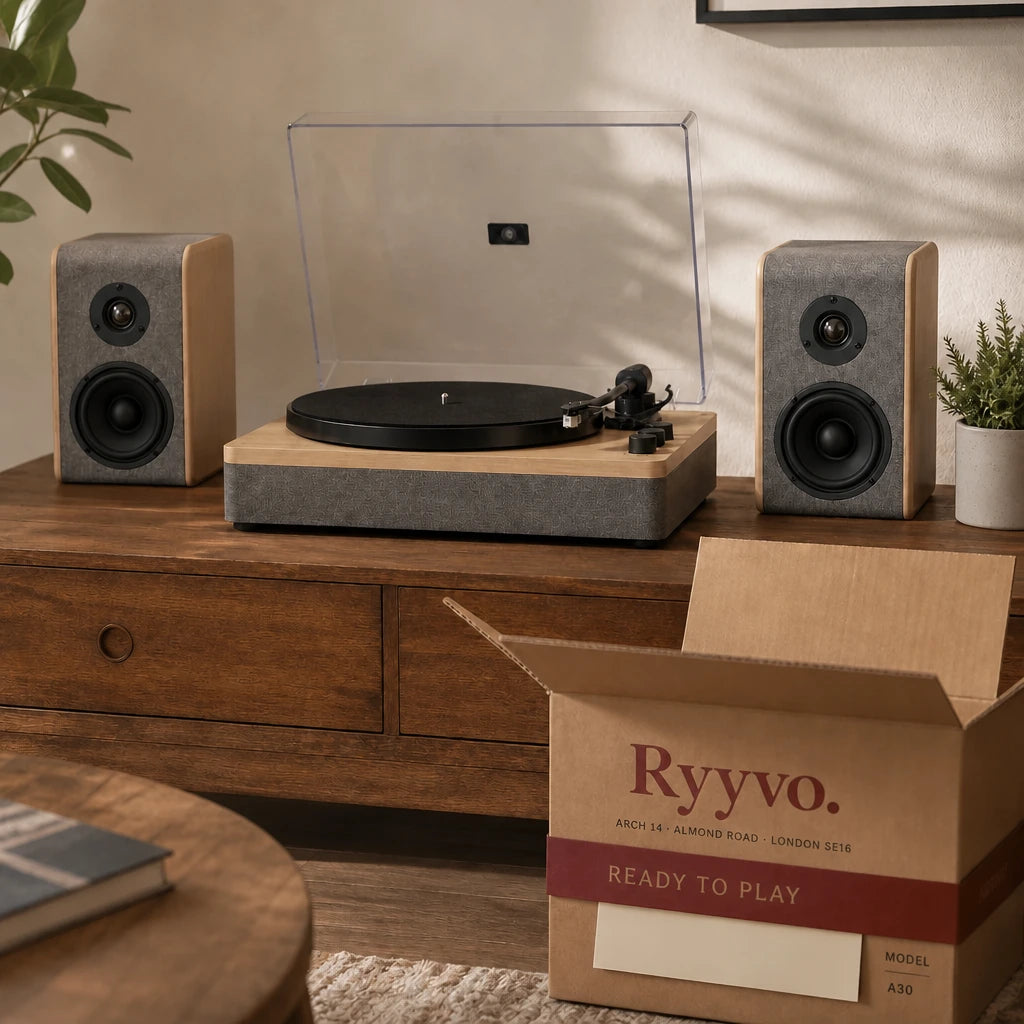
- The turntable, on a light wood plinth with a full-size hinged dust cover
- Two separate speaker cabinets, noticeably larger than the satellites usually bundled with a deck
- A UK power adaptor and the speaker leads
- Printed instructions
Bass and treble sit on the plinth next to the power and volume knob, so you set the tone without a separate amplifier. It plays 33, 45 and 78 rpm.
The maker publishes a 12 volt, 2 amp supply, which is real amplification for two cabinets that size. What they do not publish is the output in watts a side, so there is no figure on this page.
Will this damage my records?Cartridge type not stated by the maker. We have asked.
The arm is described by the maker as semi-automatic, and that part helps: it takes itself off the record at the end of the side instead of riding the run-out groove until somebody walks over. Records get worn by being left playing as much as by anything else.
What the maker does not state is the cartridge type or the tracking force. Moving magnet presses around 1.5 to 2.5 grams; ceramic presses around 5 to 7. We have asked which this is, and we will not guess.
It plays 78s, and there is a question worth settling if that is why you are here. A 78 groove is much wider than a 33 or a 45 and normally needs its own stylus. The maker has not said whether one is supplied.
Semi-automatic is used loosely in this trade. Some makers mean the arm lifts and returns to its rest; others mean only that the platter stops. We have asked which, and this page says what the maker says until they answer.
Will it work with what I already own?Not documented by the maker. Read this before you order.
This is the one thing we cannot yet answer on this deck, and it matters enough to say plainly rather than bury.
No RCA output, headphone socket or aux input appears in the maker's specification table, and the only face they have photographed carries the three control knobs and nothing else. So we do not know what you can plug into it beyond its own two speakers.
It is the first question we have put to them. If the answer decides your purchase, because you already own an amplifier or because you want to add better speakers later, tell us and we will chase it before you order.
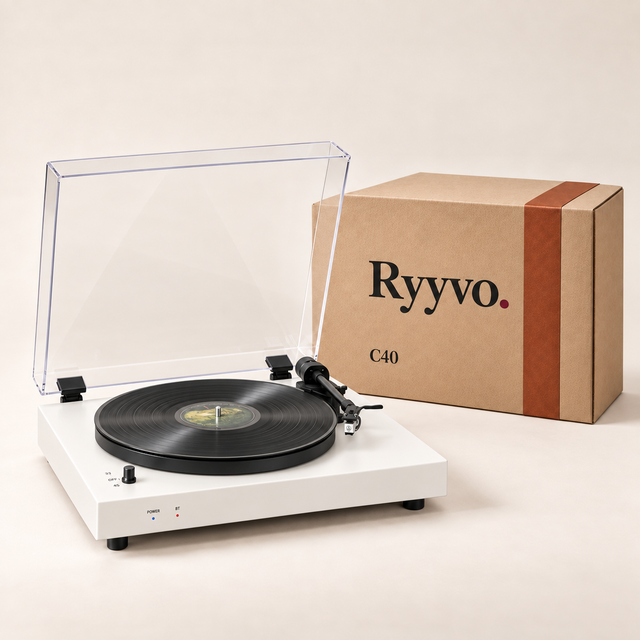
If you need a confirmed output today, the S20 has an RCA socket at £199 and the C40 has one at £319. Both are documented by their makers in writing.
Ask us before you orderWhat if it is a gift, or I change my mind?
Both are covered by the same thing: 30 days to send it back for any reason. You do not need to explain yourself, but do contact us first so we can send you the return address.
Buying for someone else? Two things are worth knowing before you order, and neither of them is about the turntable:
- Whether they have anything to play it through. A deck with no speakers, given to somebody with no amplifier, makes no sound on the day. If you are not sure, choose one with its speakers in the box.
- Whether they already own records. If they have inherited a collection, the cartridge line above is the part that matters to them.
Every turntable also carries a two-year warranty covering parts and labour.
Tell us what they already own and we will tell you which one to get. If the answer is that they do not need anything from us, we will say that too.
Ask us before you buy01 — The object
What you are actually looking at.
The parts that decide how it plays, and what each one is for. Tap a number.
-
Two separate speaker cabinetsLarger than the usual bundled pair
Noticeably bigger than the satellites normally thrown in with a deck at this price, and they are in the box. The maker publishes a 12 volt, 2 amp supply, which is real amplification for cabinets this size — but they do not publish an output in watts a side, so there is no figure on this page.
-
A semi-automatic armStated by the maker, not yet qualified
Semi-automatic normally means the arm takes itself off the record at the end of the side, so you are not required to be in the room when the music stops. Some makers use the term to mean only that the platter stops turning. Those are meaningfully different things, we have asked which this is, and until it is in writing this page says what the maker says and nothing more.
-
Bass and treble, on the deck itselfThree controls
The specification table lists bass adjustment. The maker's own photographs show three rotary controls marked BASS, TREBLE and POWER/VOL, so there is more tone control here than the specification admits to. Treat the treble control as something we have read off a photograph rather than something written down.
-
Three speeds, including 7833, 45 and 78 rpm
78 is shellac: pre-1960 records, and a genuinely different object. A 78 groove is much wider than a 33 or a 45, and normally needs its own stylus. The maker has not said whether one is supplied, so if you are buying this for an inherited box of shellac that is the question to have answered first.
-
A full-size hinged dust coverCovers the whole plinth
Hinged rather than lift-off, so it stays with the deck. Dust in a groove is played back as noise, and a closed lid is the cheapest record care there is.
Specifications, exactly as the maker states them
A turntable on a light wood plinth with a full-size hinged acrylic dust cover, supplied with two separate stereo speakers. It plays at three speeds including 78, it has tone controls on the plinth itself, and the manufacturer describes the arm as semi-automatic. That last point is the most interesting thing about this deck and it has a section of its own further down, because the term is used loosely and we have not had it confirmed.
It is made in Guangdong, China, by ELETREE, on a private mould, under the manufacturer's own reference SW-668. We have not renamed the internals and we have not invented the numbers. Where the manufacturer has not stated something, it is written plainly further down this page rather than smoothed over.
Specifications published by the manufacturer
| Manufacturer's product name | BT vinyl record player |
| Brand | ELETREE |
| Manufacturer's model reference | SW-668 |
| Country of manufacture | Guangdong, China |
| Private mould | Yes |
| Playback speeds | 33, 45 and 78 rpm |
| Tonearm | Semi-automatic |
| 45 rpm adaptor | Built in |
| Tone control | Bass adjustment |
| Power supply | DC 12 V, 2 A |
| Materials | Plastic, wood, electronics |
| Finishes offered by the factory | Walnut and light wood |
| Compliance | CE marked |
| Sold as | Single unit |
The arm is semi-automatic, and that is the most useful thing on this page
On a fully manual deck, the arm stays where you left it. When the side finishes, the stylus rides the run-out groove and the platter keeps turning until somebody walks over and lifts it. Everyone who owns a manual deck has fallen asleep to that sound at least once.
Semi-automatic normally means the arm takes itself off the record at the end of the side. You still cue it by hand at the start — that part is deliberate, because it is the part people enjoy — but you are no longer required to be in the room when the music stops.
We have not had the exact behaviour confirmed. Some manufacturers use semi-automatic to mean the arm lifts and returns to its rest; others use it to mean only that the platter stops turning and the arm stays down. Those are meaningfully different things and we have asked which one this is. Until the answer is in writing, this page says what the manufacturer says — the arm is semi-automatic — and nothing more.
Three speeds, and a word about 78s
33 and 45 rpm cover essentially every record pressed today. 78 is shellac: pre-1960 records, and a genuinely different object. A 78 groove is much wider than a 33 or 45 groove, and the stylus that fits one does not properly fit the other. Playing a 78 with a standard stylus is a compromise in both directions — it sits too deep in the groove and reads the walls badly.
The manufacturer has not said whether a separate 78 stylus is supplied, or whether the fitted one is intended to cover all three speeds. If you are buying this for an inherited box of shellac, that is the question to have answered first, and we have asked it.
Bass and treble, on the deck itself
The specification table lists bass adjustment. The manufacturer's own photographs show three rotary controls on the front right of the plinth, marked BASS, TREBLE and POWER/VOL — so there is more tone control here than the specification admits to.
Treat the treble control as something we have read off a photograph rather than something the manufacturer has written down. It is almost certainly there. It is not yet confirmed in writing.
What the power supply tells us, and what it does not
12 volts at 2 amps — 24 watts available at the wall. For comparison, a deck that ships with no speakers of its own typically runs on a 10 watt supply, which is enough for a motor, a preamp and a Bluetooth radio and not much else. 24 watts is consistent with a deck that has to drive two cabinets of this size.
What it does not tell you is how loud it goes. The manufacturer has not published an output figure in watts per channel, so we are not going to print one. The supply says there is real amplification in here. The number that would tell you what that amounts to has not been given.
What is visible in the photographs
Read off the manufacturer's own images, not written by them. Treat it as observation rather than specification.
- A rectangular plinth in a light wood finish, low and flat rather than boxy
- A full-size hinged clear acrylic dust cover
- A black platter
- A straight tonearm with a headshell and the cartridge visible at the end
- Three rotary controls on the front right of the plinth, marked BASS, TREBLE and POWER/VOL
- Two separate speaker cabinets with wood-toned tops and grey fabric wrap, noticeably larger than the small satellite speakers usually bundled with a deck
- No CD drawer, no radio dial, no cassette door and no recording controls anywhere on the unit
Not stated by the manufacturer
These are the things we have asked for and do not yet have in writing. Nothing here is a defect; it is simply not confirmed, and we would rather you knew that than read a number we made up.
- Which sockets are on the deck. No RCA output, headphone socket or aux input appears in the specification table or in any photograph. At this price that matters, because it decides whether you can ever run this into better speakers. It is the first question we have asked.
- What semi-automatic does exactly — arm lift and return, or platter stop only
- The cartridge type and model, and whether it is moving magnet or ceramic
- Tracking force in grams — the number that decides how fast your records wear
- Whether the stylus is replaceable, and its part number
- Whether a separate 78 rpm stylus is supplied
- Drive type — belt or direct
- Whether the Bluetooth transmits, receives, or both
- Speaker output power, impedance, and whether the cabinets are passive or self-powered
- Frequency response
- Whether the arm has an adjustable counterweight or anti-skate
- Product and carton dimensions, and weight
- UK plug type and the adaptor supplied
- Exact box contents and cable lengths
- Manufacturer's warranty period
A note on the finish
The factory offers this deck in walnut and in light wood. We stock the light wood. The manufacturer lists the materials as plastic, wood and electronics without saying whether the finish is a veneer or a printed foil over MDF, so we are not going to describe it as either.
Do I need a phono preamp?
A record player puts out a much weaker signal than anything else in your house, so it needs a phono stage somewhere. The only question is where that stage sits.
If the deck comes with its own speakers, the phono stage is already inside and there is nothing to work out. If you are plugging into an amplifier, look on the back for a socket marked PHONO and use it. If your amplifier only has LINE, AUX or CD sockets, you need a deck with its own phono stage or a separate box from about £25.
This page states what this particular turntable has, and says so plainly where the maker has not told us.
Ask us what works with yoursWhen does the stylus need replacing?
A stylus wears out somewhere around 500 to 1,000 hours of playing, depending on the type. A worn stylus does not just sound duller — it damages every record you play with it. If you cannot remember ever changing one, it is probably due.
Where the maker names the cartridge, the replacement is a stock part you can buy from any decent dealer rather than something only we can supply. That is stated on this page for each model.
What if I get it home and it is the wrong one?
Thirty days to send it back for any reason. You do not need to explain yourself, but do contact us first so we can send you the return address. Keep the original box if you can - a turntable posted back loose tends to arrive damaged, and that becomes a problem for both of us.
Every turntable also carries a two-year warranty covering parts and labour.
Delivery and returnsWhen will it arrive, and what does delivery cost?
Delivery is free on every order across the United Kingdom, with no minimum spend and no surcharge for the Highlands or the islands. The expected date for your address is shown at checkout before you pay.
Everything travels tracked, and the tracking number reaches you by email once the parcel is collected.
Track your orderPut a record on tonight.
You open the box, lift the lid and drop the needle. If it turns out not to be the right one, you have thirty days to send it back.
- Free UK delivery
- 30 days to change your mind
- Two-year warranty
- A phone number that answers
This one £269
Still not sure? Ask usWhat else you need
One record needs more than one box.
The price of a turntable is not the cost of listening to records. Here is what is missing, said before you order rather than after.
If none of this is what you need, tell us what you already own and we will tell you what works with it — including when the answer is that you do not need anything from us. Ask us